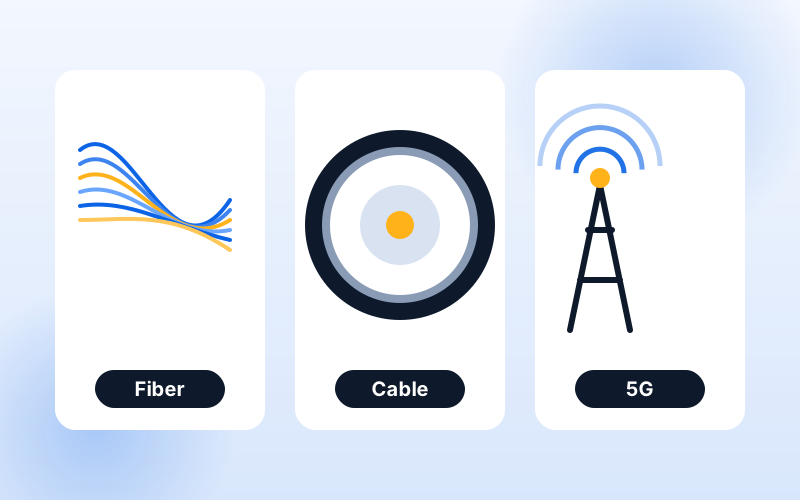
If you're shopping for home internet, you'll likely see fiber, cable and 5G home internet offered at your address, and sometimes satellite or DSL. They all get you online, but they behave differently once several people are streaming, gaming and on video calls at the same time.
Fiber internet
Fiber sends data as light through glass strands all the way to your home. It's the most consistent connection type and many fiber plans offer the same upload speed as download speed. That matters if you work from home, upload large files, stream to an audience or have several people on video calls.
Choose fiber if it's available at your address and you want the most reliable connection. The main drawback is availability: fiber hasn't reached every street.
Cable internet
Cable internet runs over the same coaxial lines used for cable TV. It's available at most US addresses and offers fast download speeds. Upload speeds are usually much lower than download speeds, and speeds can dip at peak times in busy neighborhoods.
Choose cable if fiber isn't available, or if a cable plan gives you the download speed you need for less. Look closely at the price after any promotional period.
5G home internet
5G home internet (also called fixed wireless) uses a cellular network. A receiver in your home picks up the signal and creates your Wi-Fi network. Setup usually takes minutes, and many plans have no annual contract.
Choose 5G home internet if the signal at your address is strong and you want simple setup and pricing. Speeds depend on your distance from the tower, obstacles and how many people use the network nearby, so check coverage at your exact address first.
What about satellite and DSL?
Satellite internet is often the best choice for rural homes with no wired option. Newer low-orbit satellite services have much lower latency than older satellite internet. DSL runs over phone lines and is usually the slowest wired option, but it can be a fallback where nothing else is available.
Quick comparison
| Type | How it reaches you | Good for | Watch for |
|---|---|---|---|
| Fiber | Fiber-optic line to the home | Fast, steady speeds and equal upload and download on many plans. Great for remote work and gaming. | Not available at every address yet. |
| Cable | Coaxial TV cable | Widely available with high download speeds. | Upload speeds are usually much lower than download. Prices often rise after the promo period. |
| 5G / fixed wireless | Cellular signal to a home receiver | Quick self-setup, often no annual contract. | Speed depends on signal strength and network traffic at your address. |
| Satellite | Dish to a satellite | Rural homes with no wired option. | Equipment cost and weather. Older satellite services have higher latency. |
| DSL | Phone line | Basic browsing where nothing else reaches. | Slowest of the wired options. |
How to choose
- Check what's actually available. Availability is address-by-address. The FCC National Broadband Map shows which providers report service at your location.
- Count your users. Add up the people and devices online at the same time, and what they do.
- Check upload speed if anyone works or studies from home.
- Read the broadband label. US providers must show a standard label with price, fees and typical speeds for each plan.
- Compare month 13, not just month 1. Promotions end.
Want someone to check for you? Send us your ZIP code and we'll compare the fiber, cable and 5G options at your address. Or see our home internet plans page.